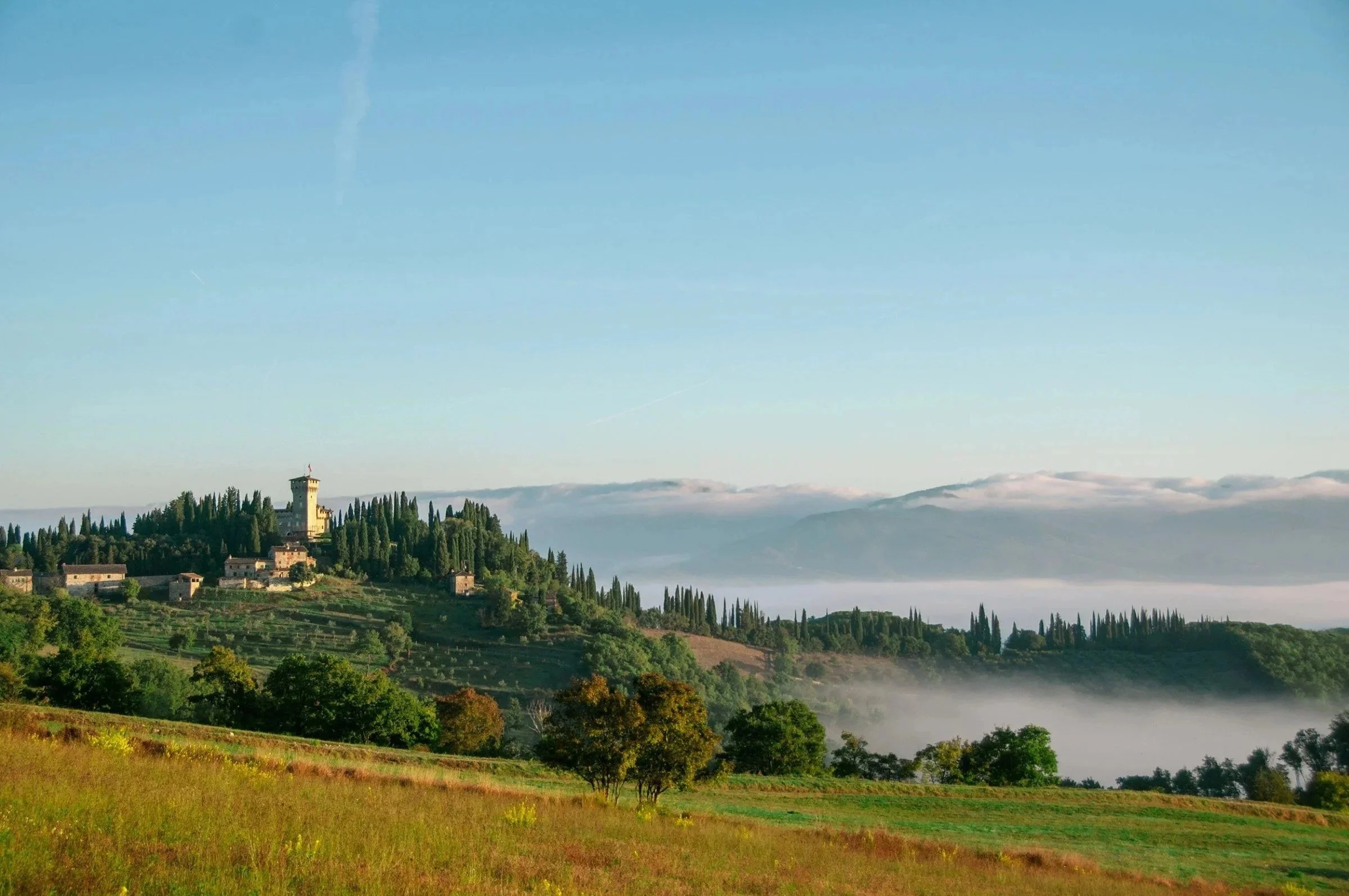
Twenty kilometers north of Florence, past the point where the tour buses turn around, the Mugello opens up into a landscape that looks like the background of a Renaissance painting. On one of the hills there is a squat castle with a tower, cypresses running down the ridge, and a stone borgo clustered below it.
This is Il Trebbio. The castle belonged to the Medici, and at Cosimo de' Medici's request the architect Michelozzo rebuilt it into what is generally called the first Florentine Renaissance villa: the moment a fortress stopped being a fortress and became a house with a garden. It is part of a UNESCO World Heritage site. Walkers on the Via degli Dei, the old path between Bologna and Florence, still pass close by.
Today the estate is in the care of the Corsini family, whose history in Tuscany runs back more than nine hundred years. In 2015 they started planting olives.
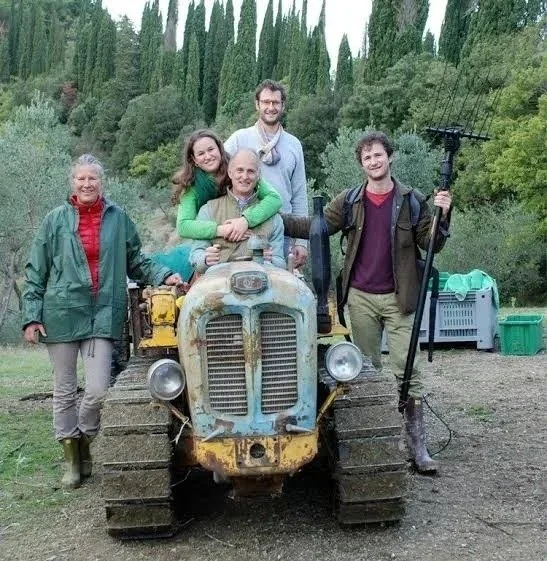
From left: Gabriella, Dianora, Clemente, Lodovico and Niccolò Corsini.
They planted an olive grove
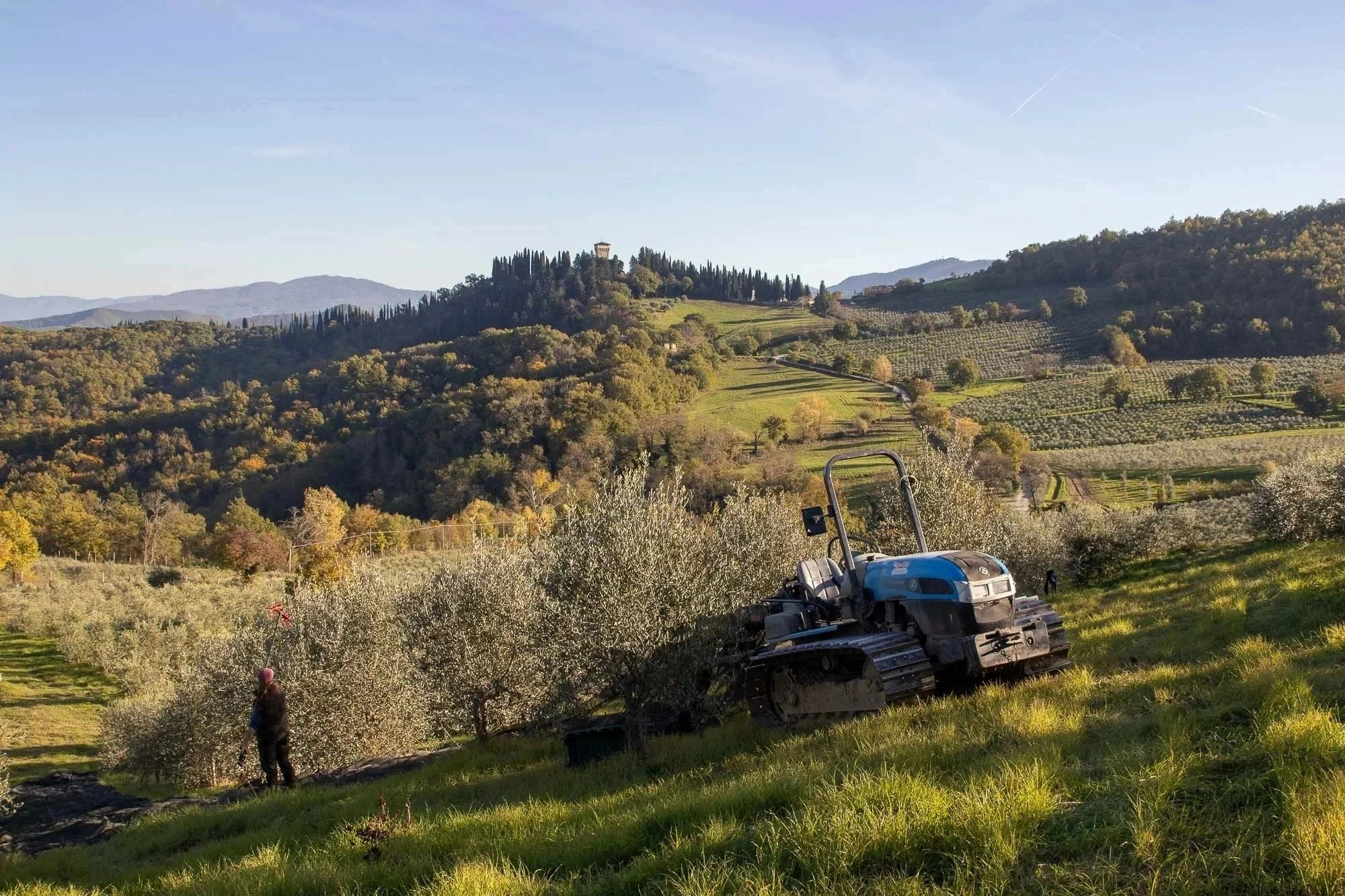
Not a few trees. Ten thousand went into the ground that year, followed by another twenty thousand between 2017 and 2019. The new plantings alone now come to around thirty thousand trees, spread with the older groves across seventy hectares of the estate, at an average of four hundred meters above sea level.
It had been an idea for a long time before that. Clemente Corsini describes it as a dream he had carried for more than twenty years, a way to preserve the family's heritage in Tuscany and, after years spent abroad, to give his own children roots in the Mugello. Planning began four years after the family became the estate's custodians. The new terraced fields were laid out partly to recreate and expand the ancient groves that a devastating frost destroyed in 1985, and hundreds of surviving old trees were lifted and replanted across the property rather than cleared.
It is a family project in the literal sense: Clemente and Gabriella, and their children Lodovico, Niccolò and Dianora, with a young team led by Stefano Giannini, almost all of them from the Mugello.
"Our innovative olive grove, farmed under strict biodynamic principles, yields exceptional produce with unique qualities. As a family, we remain rooted in our Tuscan heritage while projecting innovatively into the future."
Clemente, Gabriella, Lodovico, Niccolò and Dianora Corsini
What biodynamic means on this hill
Biodynamic farming attracts a certain amount of eye-rolling, and some of it is earned. What is worth paying attention to is not the philosophy but what a grower actually has to do, and at Trebbio the practice shows up in the oil.
The grove is certified biodynamic in Italy by AgriBioDinamica. Soil fertility is managed with preparations made from herbs, minerals and animal manures, applied in small quantities, and the estate composts its own material rather than buying fertility in. After pruning, a mist of propolis goes across the fields. It is antimicrobial and antifungal, and it protects the open cuts. The young trees are staked with chestnut rather than metal, which costs more and which the family chose so the groves avoid unwanted electromagnetic fields. You can take that last one or leave it; the point is that somebody is thinking at that resolution.
The older parcels are harvested slowly, by hand, and Gabriella checks the health of individual trees while she picks. The newer blocks were grafted and planted in modern configurations so that adapted machine harvesters could work them, which raised production and, more usefully, freed up time to spend on quality.
"To be honest it was the only way to go. I want to leave the land to my children in a better condition than how I found it."
Gabriella Corsini, on choosing biodynamic
The olives are picked early, in October, while they are still turning. That costs yield, because an olive gains weight and oil as it ripens, and it buys aroma, bitterness and pepper instead. They are pressed cold and straight away, and filtered after.
Then the part that matters most for what ends up in your kitchen: the oil goes into stainless steel under inert gas at a controlled temperature, and each tank holds a single variety.
One tank per variety is the whole reason this estate can make monovarietals at all. Keep the varieties apart from the tree to the bottle and you can offer a Leccino that tastes only of Leccino. Pour them into one tank and you have a house blend, a perfectly good thing and a different thing. It is an expensive way to organize a cellar, and few estates bother.
The man who decides what it tastes like
Keeping the varieties apart is only half of it. Somebody then has to decide what to do with them: which tanks get bottled on their own, and what goes into the blends.
That is Stefano Giannini. He has local roots like the rest of the team and has been part of Trebbio from the very beginning. He heads operations in the fields, and he is in charge of defining the taste profiles and making sure every step of production is tuned for what he wants in the glass. From sun exposure in a given parcel to whether to filter at milling, the decisions run through him.
The point of that work is not consistency for its own sake. It is that an assembled oil can be something none of its parts manage alone. A master blender makes that argument about whiskey, and olive oil has rarely been given the same credit. Trebbio's blends have been described, accurately, as delicately nuanced, and the precision involved is closer to a wine sommelier's than to anything you would associate with a commodity condiment.
"Italy possesses a unique advantage that no other country enjoys: over 500 distinct olive varieties. With such a vast array of tastes at our disposal, we should be capitalising on this advantage on the global stage."
Stefano Giannini, head of operations
Ask him what people get wrong about olive oil and the answer is blunt. The problem, he says, is misinformation. A shopper in a supermarket has no way to tell one extra virgin from another and so falls back on the brand. Dianora adds that the color of an oil tells you nothing about its taste and is routinely adulterated in the mass market, and that the common belief that olive oil is bland is simply wrong.
Clemente puts the same thought the other way up. Most people treat olive oil as a plain condiment, he says, when it can offer a kaleidoscope of flavors: an experience and a product in and of itself.
A grove that is also a laboratory
Trebbio is part of the Revolution study, run with Professor Mancuso's department at the University of Florence, which is trying to pin down what actually separates good olive oil from great: environmental conditions, hydration and the rest. Parts of the groves are given over to the research, and students come to the property for field work.
There is hardware to match. A network of Terraprima Ladybird sensors reports soil and hydration data in real time, giving the team a live picture of the grove's health and making every bottle traceable back to the ground it grew in.
An experimental grove
The planting itself is unusual. Trebbio's grove mixes traditional and modern planting patterns on the same hillside, and carries more than fifteen Tuscan varieties, predominantly Leccino, Leccio del Corno, Frantoio, Moraiolo, Pendolino and Maurino. Where old trees could be saved, they were transplanted rather than cleared.
The point of planting that many varieties is to find out what each one does here, at this altitude, in this soil, which runs 61% silt, 25% clay and 14% sand. Some of them will turn out to be worth bottling on their own, and the only way to learn which is to grow them.
And then they found one nobody had
Among the old trees on the estate was a variety the family could not identify.
They sent it to Italy's National Research Council, the CNR, which confirmed it as endemic to this valley. The family named it Dianora del Trebbio, after their daughter.
There is no version of that story that is not a good one. A family with nine centuries of history, a grove ten years old, and a Tuscan olive variety that was on the property the entire time, waiting for someone to ask.
The judges have noticed
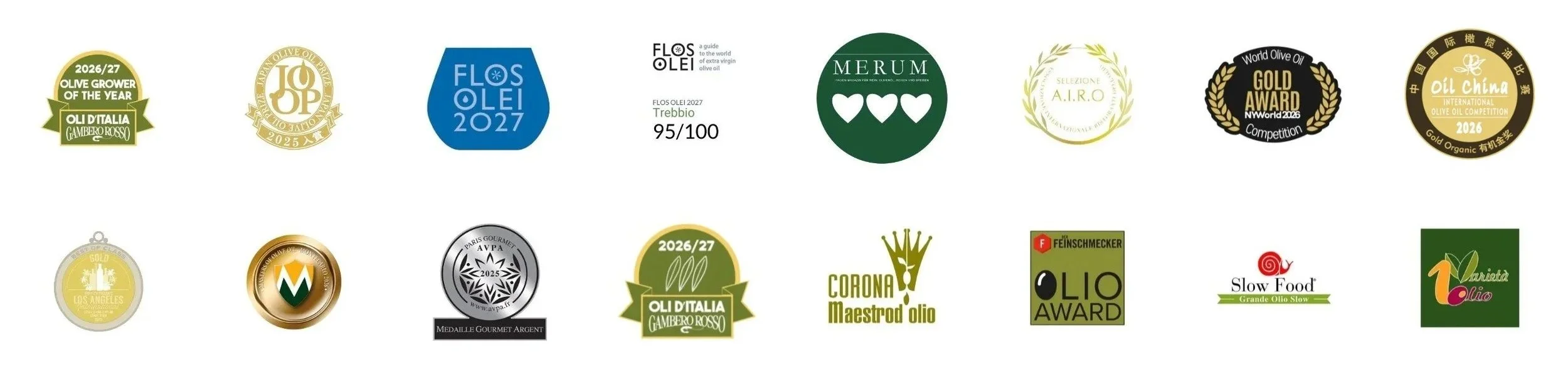
Quickly, for a grove this young. A selection:
Gold at the NYIOOC World Olive Oil Competition 2026 in New York for the Frantoio, the Leccio del Corno and the Peppery-Intense, following three golds at the 2025 competition.
Olive Grower of the Year (Olivicoltore dell'anno) from Gambero Rosso, in its Oli d'Italia 2027 guide.
Three golds at Oil China 2026, the 21st edition of the competition, for the Leccio del Corno, the Peppery-Intense and the Leccino.
Four golds at the Los Angeles International EVOO Competition 2025, and ten honors at JOOP 2025 in Tokyo.
Tre Foglie from Gambero Rosso's Oli d'Italia, the guide's highest mark, for the Leccio del Corno.
Grande Olio Slow in Slow Food's Guida agli Extravergini 2025, which judges how an oil is made as much as how it tastes, for the Leccio del Corno and the Peppery-Intense.
Two stars at Il Magnifico 2025, Florence's own competition, for the Leccio del Corno, and one star each for the Leccino and the Peppery-Intense.
8.0 points at the 22nd Rassegna Nazionale degli Oli Monovarietali, Italy's national review of single-variety oils, again for the Leccio del Corno.
Two silvers and a bronze at AVPA in Paris, 90 points in Flos Olei, and a place in Der Feinschmecker's Top 100 Olive Oils of the Year.
The full list lives in Trebbio's own field notes, and it is longer than this.
Chefs got there before the retail market did. The blends have been taken up by kitchens in Italy and across Europe; a pomodoro jelly at Racines in Brussels is one. The estate runs tastings on site that begin with a walk through the groves, which is the most honest way to sell any of this.
The dove
The mark on the bottle is a dove carrying an olive branch, the oldest possible image for this, and a slightly unexpected choice for a family with a castle. It sits in white on the black glass, under an acid-yellow neck band.
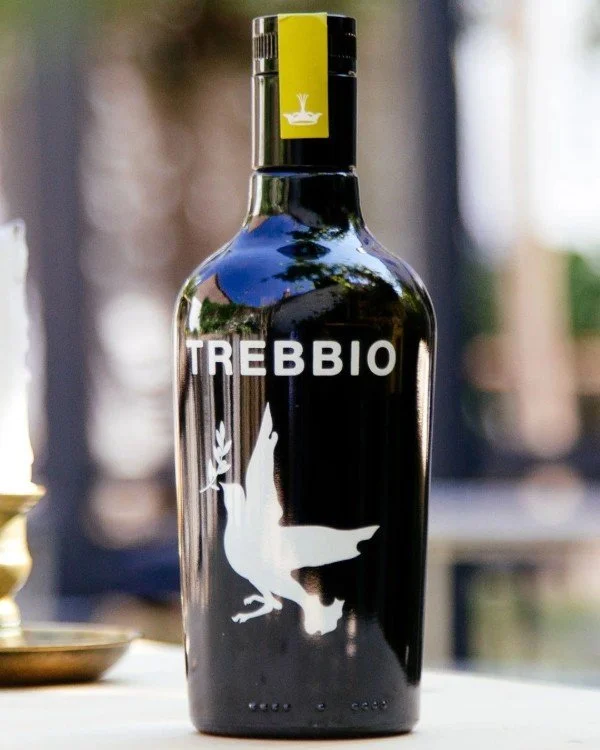
You will find it on four oils on this site. Peppery-Intense is the five-variety estate blend. Leccino, Frantoio and Leccio del Corno are each a single variety from a single tank. They arrive in early 2027 from the October 2026 harvest. See all four and join the list to hear the day they land.
For more on the family and the estate, visit our Trebbio producer page.
Nine hundred years is a long time for a family to be anywhere. Ten is not very long at all to start making oil this good.
Start here: what a monovarietal olive oil actually is.
